Introduction: The Hidden Value of Waste
In any commercial layer operation, managing manure is often treated as a necessary cost—a burden of disposal and compliance. However, high-quality, fully managed chicken manure is one of the most potent, natural fertilizers available, rich in essential plant nutrients. By implementing a systematic composting and stabilization protocol, you can transform this waste product from a cost center into a valuable, marketable source of income.
At Essential Farm, our Pillar 4: Farm Management includes a protocol for waste monetization. This article details the science and steps required to convert raw manure into a safe, premium-grade agricultural product, closing the loop on your farm’s sustainability and securing a new revenue stream.
Embracing the New Norm: Drought Tolerant Plants
In Los Angeles, where water scarcity is an ever-growing concern, the shift toward drought-tolerant landscaping is more essential than ever. Homeowners and businesses alike are seeking beautiful, sustainable gardens that thrive with minimal water—and drought-resistant plants offer a perfect solution. These resilient species don’t just survive dry conditions—they flourish in them, making them ideal for the Southern California climate.
- The Raw Manure Problem: Why It Cannot Be Used Directly
Raw chicken manure cannot be applied directly to crops. It poses severe risks due to its chemical composition and potential pathogens.
A. High Ammonia Content (Chemical Risk)
Raw manure is extremely high in Nitrogen, much of it in the form of Uric Acid and Urea. As this breaks down, it releases high concentrations of Ammonia gas ($\text{NH}_3$).
- The Result: Direct application causes “burning” of plant roots and leaves, resulting in crop damage and nutrient loss to the atmosphere.
B. Pathogens and Weed Seeds (Biological Risk)
Raw manure is a reservoir for harmful bacteria (E. coli, Salmonella) and parasites (Coccidia oocysts). It also often contains viable weed seeds consumed by the birds.
The Risk: Applying these pathogens and weed seeds to a food crop or pasture creates severe food safety risks and increases labor costs for weeding.
- The Solution: Thermophilic Composting (Pathogen Elimination)
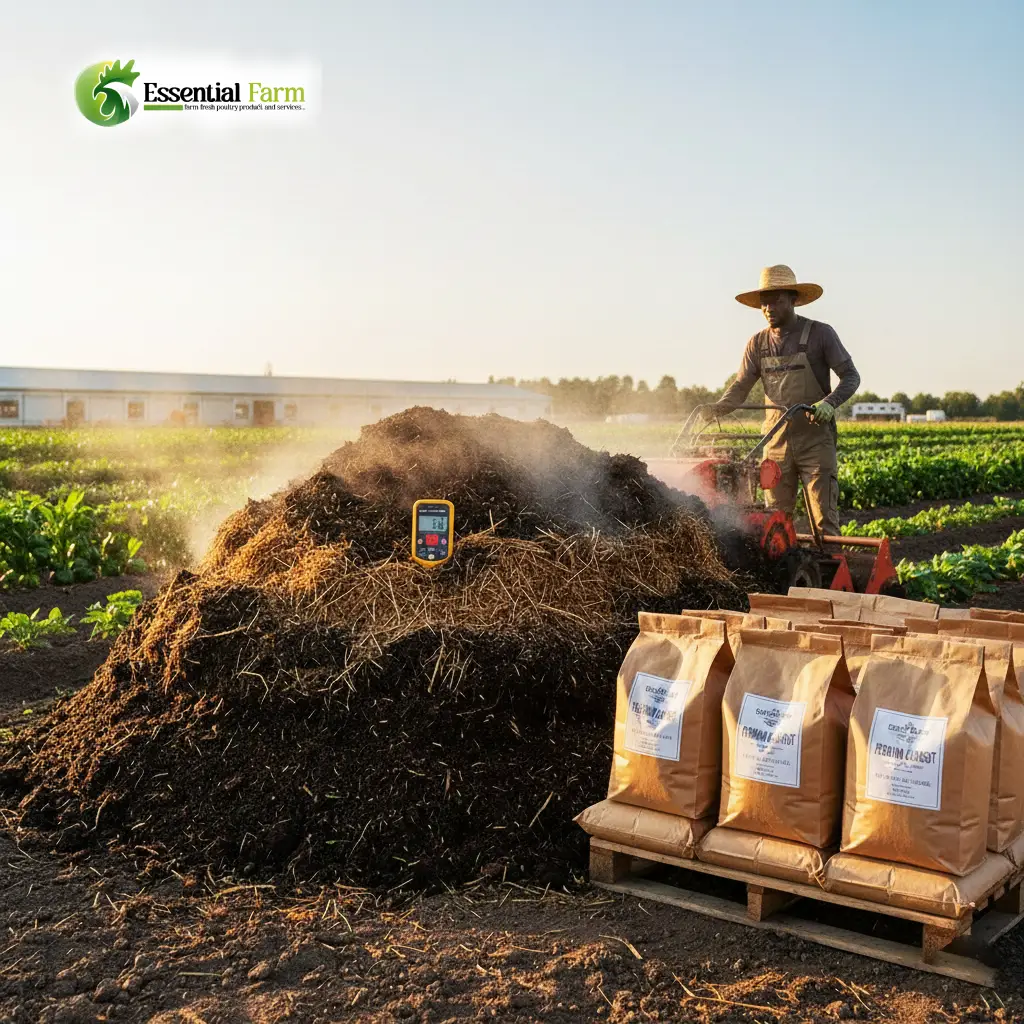
The only way to safely convert raw manure into fertilizer is through controlled Thermophilic Composting—a process that uses microbial heat generation to kill pathogens and stabilize nutrients.
A. The Carbon-to-Nitrogen (C:N) Ratio
Successful composting hinges on achieving the correct balance between Carbon (C, the energy source) and Nitrogen (N, the protein source). Raw chicken manure is extremely high in N (low C:N ratio), so it must be blended with a Carbon source.
- Target Ratio: The ideal C:N ratio for composting is between 25:1 and 30:1.
- Essential Farm Protocol: We blend dried chicken litter with high-carbon materials like sawdust, rice hulls, or chopped straw to achieve this ratio. This blend ensures the microbial community has the right fuel mix to generate the necessary heat.
B. The Temperature Mandate (The Kill Step)
The core principle of composting is using heat to sterilize the material.
- Thermophilic Phase: The microbial activity must raise the internal pile temperature to 55°C (131°F) for a sustained period of at least 3 days (ideally 15 days total). This heat surge kills all weed seeds, E. coli, Salmonella, and Coccidia oocysts.
- Turning: The pile must be mechanically turned at least five times throughout the process to ensure every part of the manure mix reaches the required sterilization temperature.
- Product Stabilization and Marketable Value
After the thermophilic phase, the compost must cure (mature) to stabilize the nutrients and maximize market value.
A. Nutrient Stabilization (Curing)
During the final curing phase (4 to 6 weeks), the remaining organic matter breaks down further. The volatile Ammonia gas is converted into stable forms of Nitrogen (Nitrates and Ammonium), which are readily available and safe for plants.
- Final Product: The final product is dark, crumbly, and has an earthy smell (no ammonia odor). This stabilized product is ready to be marketed as a soil amendment.
B. The Premium Fertilizer Analysis
Managed compost is a highly valuable, slow-release fertilizer with a typical N-P-K (Nitrogen-Phosphorus-Potassium) ratio of approximately 3:2:2, but its value goes beyond the macronutrients.
- Micronutrient Richness: It is rich in essential micronutrients like Calcium, Magnesium, and Zinc, making it a “complete” fertilizer.
- Soil Structure: It significantly improves soil structure, aeration, water retention, and microbial biodiversity—qualities that synthetic fertilizers cannot replicate.
Conclusion: New Income, Better Compliance
By implementing a controlled composting system, you transform a liability into a high-demand commodity. This process not only opens a new income stream by selling premium compost to gardeners and other farms but also guarantees environmental compliance by safely handling waste.
Essential Farm’s Farm Management training provides the precise C:N mixing ratios, temperature tracking protocols, and curing guidelines required to ensure your manure is converted into a safe, marketable Premium Farm Income product, securing a truly closed-loop, profitable operation.