
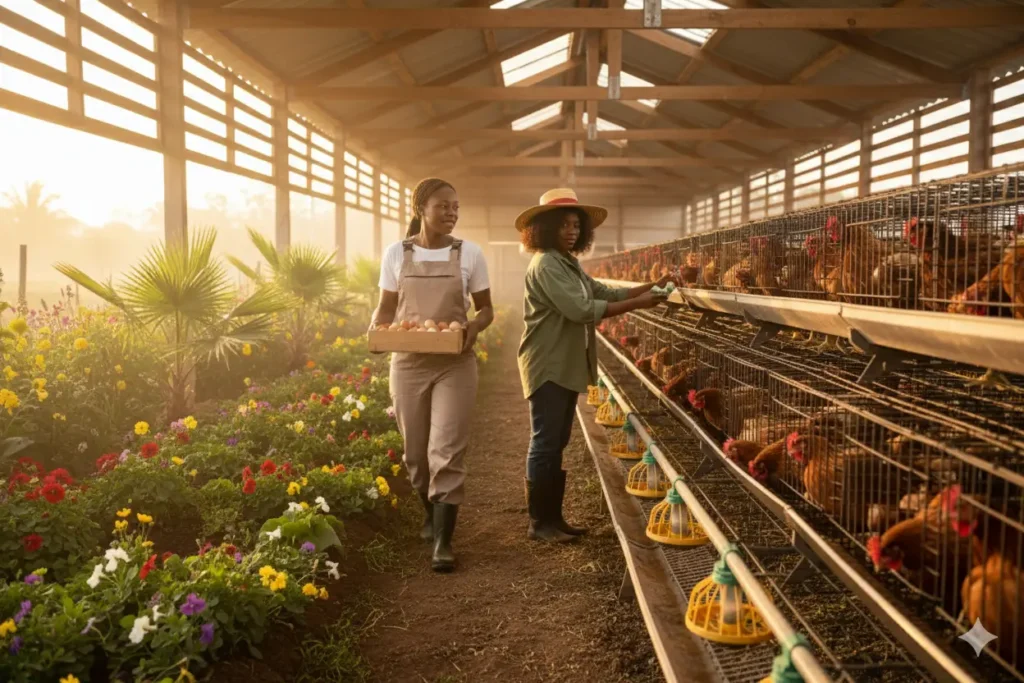
Practical answers.
Real farm experience.
Clear, experience-based explanations on flock health, brooding, culling, biosecurity, feed management, and produce quality — grounded in what actually happens on the farm.
Nothing matched that search.
Try a different term, or reach out and we'll answer directly.
Talk to Our TeamSection I
General Questions
The fundamentals — why biosecurity matters, how the systems work, and the core principles behind everything Essential Farm does.
Get To Know More About UsWhy is Biosecurity so strict at Essential Farm?
What is the Critical Week 13 Transfer?
Why are my eggshells suddenly weak and breaking?
Why do you deworm so often? I usually skip it.
When do you use Antibiotics?
What is the 80% Uniformity Rule?
Should I debeak my birds?
What is the All-In, All-Out System?
Section II
Culling & Efficiency
Keeping birds past their profitable stage is one of the quietest ways farms lose money. Here's how to know when, why, and how to act.
View Culling & Efficiency ServiceWhat is culling, and why is it essential in a profitable poultry operation?
How does Essential Farm determine the correct time to cull a flock?
Why is delaying culling financially dangerous for farms?
What is the All-In, All-Out (AIAO) system, and why is it mandatory?
What happens immediately after flock depopulation?
Does Essential Farm assist with the sale of culled birds?
How does proper culling protect the next flock?
Who should use the Culling and Efficiency service?
- Layer farms experiencing declining production
- Farms holding birds out of sentiment or uncertainty
- Operations with high feed costs and low egg margins
- Farms preparing for a new production cycle
Section III
Brooding
Most lifetime losses in poultry don't happen during lay — they happen early. Temperature errors, missed treatments, and poor transitions permanently limit a bird's future output.
View Brooding ServiceWhy is brooding the most critical stage in poultry production?
How long does Essential Farm's brooding program run?
What happens during Phase 1 (Weeks 1–13)?
Why is temperature control so critical during early brooding?
What is Phase 2 (Weeks 13–18), and why is it necessary?
Why is moving birds at 18 weeks a mistake?
Is debeaking part of the brooding service?
What does the farmer receive at the end of the brooding service?
- Fully vaccinated on schedule
- Uniform in weight across the flock
- Cage-adapted and stress-conditioned
- Prepared for immediate, consistent production
Who is this brooding service designed for?
- Farmers who want predictable performance from day one
- Investors entering poultry without technical risk
- Farms tired of early losses and uneven flocks
- Operations scaling production professionally
What is the biggest advantage of outsourcing brooding to Essential Farm?
Section IV
Flock Management & Economic Culling
Even healthy-looking flocks can leak profit through feed wastage, parasites, aggression, and underperforming birds. Discipline keeps a flock productive from start to finish.
View Service PrinciplesWhat does flock management actually mean in a commercial poultry system?
Why is feed efficiency central to flock management?
What role does controlled debeaking play in flock efficiency?
How does cannibalism affect flock performance?
What is economic culling within flock management?
How do parasites quietly destroy flock profitability?
What is your deworming strategy within flock management?
Why is holding weak or non-productive birds dangerous?
How does flock management protect future production cycles?
Who is the Flock Management service best suited for?
- Medium to large layer farms
- Farms with rising feed costs and shrinking margins
- Operations experiencing unexplained production drops
- Farms transitioning to professional-scale management
Section V
Routine & Health Management
Disease rarely starts with visible symptoms. Most damage happens long before birds look sick — when vaccines fail, parasites build up, or stress weakens immunity.
View Routine & Health ServiceWhy is routine health management more effective than emergency treatment?
What happens when health management is inconsistent?
What is Essential Farm's vaccination support protocol?
How does deworming fit into routine health management?
How do parasites affect egg production and shell quality specifically?
What is your antibiotic policy?
How do you manage stress-related health risks?
How does routine health management improve profitability?
Who needs this service the most?
- Farms with recurring health issues that never fully resolve
- Operations relying heavily on antibiotics for baseline management
- Farms with inconsistent or declining egg production
- Any farm seeking long-term stability over reactive management
Section VI
Advanced Biosecurity & Feed Detox
Some of the biggest performance losses come from things you can't see: toxins in feed, lingering pathogens, and broken biosecurity habits. Birds keep eating, but output quietly drops.
View Biosecurity ServiceWhy is advanced biosecurity necessary beyond basic farm hygiene?
What are mycotoxins, and why are they dangerous to poultry?
Why can good-quality feed still contain mycotoxins?
How does the feed detox system work?
Is feed detox a short-term or continuous process?
What is the Bio-Integrity System?
How is disease introduction prevented on the farm?
What role does manure management play in biosecurity?
How does this service stabilize production long-term?
Who should invest in advanced biosecurity and feed detox?
- Farms with unexplained, recurring performance drops
- Operations experiencing frequent "mild" disease issues
- Farms seeking consistent, professional-grade output
- Investors who require predictable returns from their poultry assets
Section VII
Grade A Bell Pepper Logistics & Distribution
Quality problems don't start at delivery — they start long before harvest. Thin walls, uneven ripening, and poor handling turn good-looking peppers into losses during transport.
View Bell Pepper ServiceWhat defines a Grade A bell pepper?
Why do most bell pepper supply chains fail to deliver consistent quality?
How is quality built at the production stage?
Why is fruit wall thickness critical for logistics?
How are peppers graded after harvest?
What happens immediately after harvest?
How is shelf life preserved during distribution?
Who is this service designed for?
- Wholesalers requiring consistent volume and grade
- Supermarkets with strict quality contracts
- Exporters managing international standards
- Food processors needing uniform input specifications
- Institutional buyers with large, recurring requirements
What is the main advantage for buyers?
Why partner with Essential Farm for logistics and distribution?
Stop Losing Birds. Start Counting Profit.
Ready to build a farm
that actually performs?
We have solid blueprints and hands-on services that form the operational backbone of profitable, resilient, and scalable agricultural systems. Every system we share is one we actively use and prove in real farm conditions.