
Many Farms Don't Fail at the Start —
They Fail Because They Won't Let Go
What once made you money quietly turns into a liability — draining feed, space, and biosecurity while pretending to still be productive.
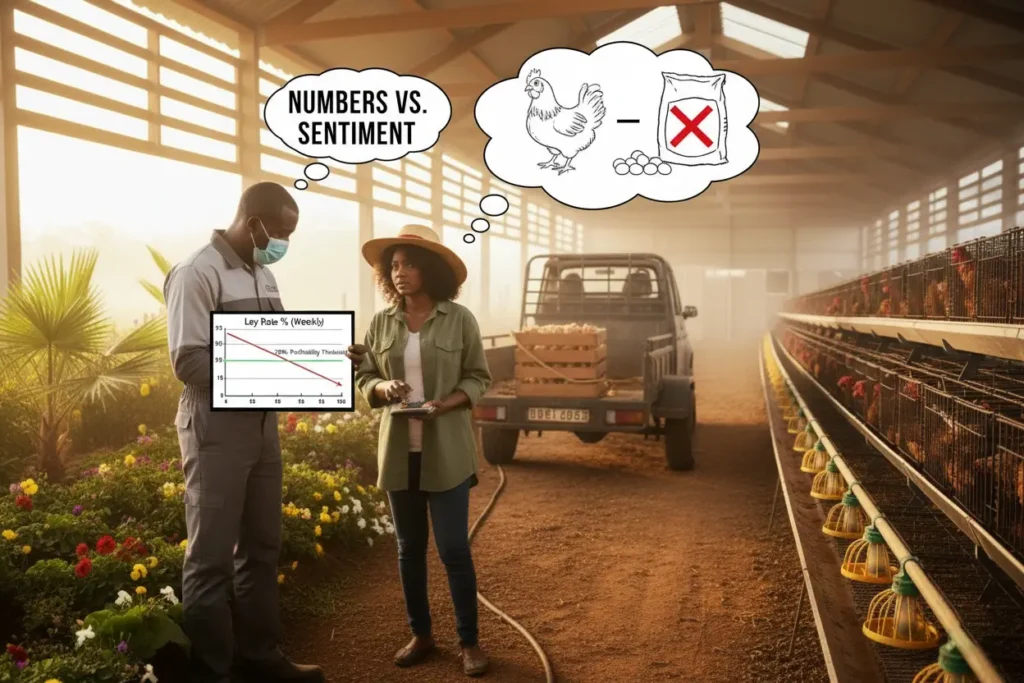
The Unprofitable Plateau
Layers hit peak production around Week 30–32, then slowly decline. Once lay rate drops below 70%, you must run the numbers. Sentiment doesn't pay for feed — performance does.
Get a Quote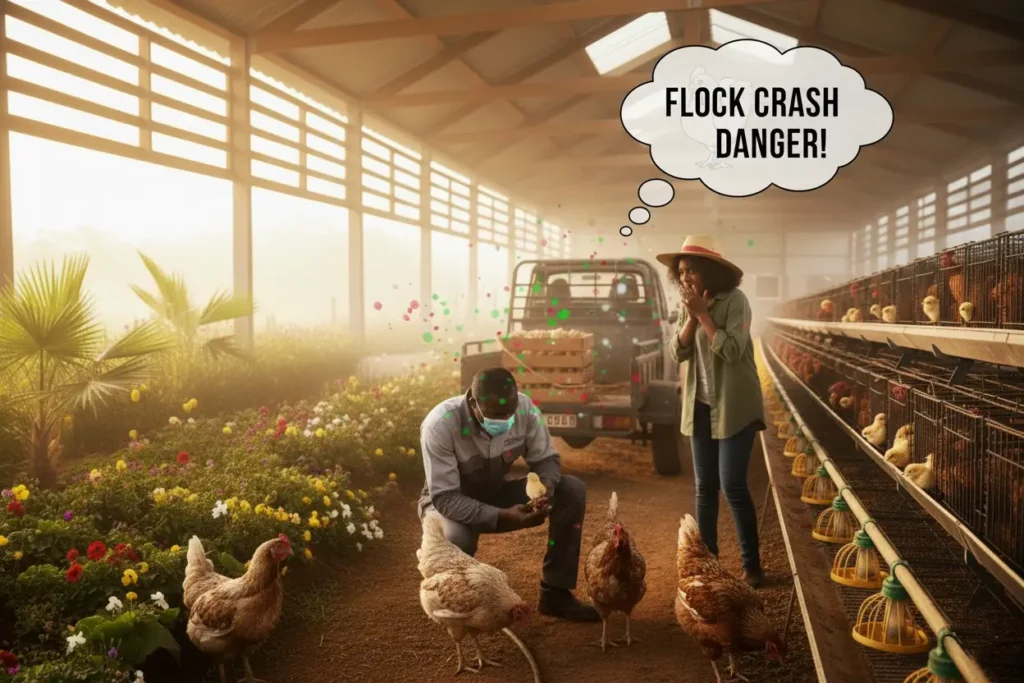
The Disease Reservoir Trap
Old flocks inevitably carry something — a low-grade infection, a parasite load, lingering viral particles. Introduce new Day-Old Chicks into that same environment and those vectors jump. It's a guaranteed flock crash.
Get a Quote
Wasted Facility Space
Every day that old, low-producing bird occupies a cage is a day a new, high-producing pullet isn't. You're sacrificing future profit for current inertia. Dead space is dead money.
Get a QuoteThe Essential Farm All-In, All-Out Protocol
We manage the entire retirement process — maximum recovery value for the old flock, a guaranteed clean slate for the next. This is the final step in a profitable, sustainable cycle.
Economic Culling Assessment
Profitability Threshold
We establish your farm's minimum viable lay rate based on current feed and egg prices. Once the flock dips below this, we initiate the retirement plan immediately.
Timing
For most breeds, the decision falls between 75–80 weeks of age. We manage logistics to ensure smooth, quick sale to local processors at maximum value.
The Clean Break: Biosecurity Mandate
Complete Depopulation
All-In, All-Out. Every single bird leaves the house simultaneously. No overlapping flocks. This immediately breaks the cycle of disease transmission from cycle to cycle.
Deep Litter Removal & Disinfection
All contaminated litter, manure, and bedding removed and safely disposed. The empty house undergoes intensive washing, broad-spectrum disinfection, and a full dry rest before the next brooding cycle begins.
Brokerage & Logistics
Market Connections
We connect you with verified local buyers and processors for old layers — ensuring a fair market price and a fast, clean transfer with zero farm disruption.
Logistics Management
We coordinate all transport and removal so your farm team can immediately shift focus to the critical deep cleaning and preparation phase for the next cycle.
The Clean Break: Step-by-Step Process
Why Essential Farm Manages Your Flock Retirement
Guaranteed Clean Slate
We are religious about the All-In, All-Out System. It's the single most effective way to protect your investment in new Day-Old Chicks from the diseases of the past.
Profit-First Decision Making
We take the emotion out of culling, providing data-driven advice on when to sell to maximize your feed conversion ratio and overall facility efficiency.
Expert Biosecurity Execution
Our clean-cycle protocol ensures the facility is ready to meet the stringent 35°C brooding requirements for the next generation — no shortcuts taken.
Late decisions are expensive decisions.
Each extra day an unproductive bird remains on the farm quietly drains profit through feed consumption and health risk — and disrupts your next cycle's timing.
Frequently Asked Questions
Everything you need to know about culling, flock retirement, and the All-In, All-Out protocol before booking your consultation.
Culling is the deliberate, planned removal of birds that have reached the end of their economic usefulness. In commercial poultry farming, birds are kept strictly on performance — not age or sentiment. Once a bird consumes more value in feed, labor, and space than it returns in eggs, it becomes a financial liability. Without culling, farms unknowingly convert productive housing into a retirement center for underperforming birds — raising feed costs, declining egg volume, and increasing disease pressure. Culling is a profit-protection mechanism.
We use economic thresholds, not guesswork. The process involves analyzing current feed costs, egg prices, daily egg output, and bird efficiency. When the average hen's egg production drops below break-even — where feed cost per bird exceeds egg revenue — we initiate the culling plan. This typically occurs between 75 and 80 weeks of age, though exact timing depends on market conditions. We answer one question: Is this bird still paying rent for its space? If no, culling is mandatory.
Delaying culling causes compounding losses. Older birds have poorer feed conversion, higher mortality risk, and weaker immune systems. They also shed more pathogens into the environment, increasing disease pressure. Each extra day an unproductive bird remains on the farm drains profit through feed consumption and health risk. Late decisions are expensive decisions — you also miss optimal re-stocking windows, lose cash flow timing, and compromise your next flock's performance.
All-In, All-Out means every bird in a house is removed at the same time — zero overlap between old and new flocks. Partial depopulation allows diseases, parasites, and residual pathogens to transfer from old birds to young ones. AIAO creates a hard biological reset. It is the single most effective biosecurity tool in commercial poultry production, and we enforce it without exception.
Once depopulation is complete, all litter, manure, feathers, and organic waste are removed from the house. The structure is then thoroughly washed, disinfected, and allowed to dry completely. Drying is not optional — it's critical for killing residual pathogens. After disinfection, the house rests before new chicks arrive, ensuring the environment is biologically safe and ready for brooding. Skipping or shortening this process undermines the entire next cycle.
Yes. We handle the complete commercial exit strategy of the flock — identifying reliable buyers, negotiating fair market prices, coordinating logistics, and ensuring fast removal. The goal is to convert old birds into immediate cash flow, not prolonged losses. This removes emotional hesitation and operational delays from the farmer, ensuring culling decisions are executed decisively and profitably.
This service is designed for layer farms experiencing declining production, farms holding birds out of sentiment or uncertainty, operations with high feed costs and low egg margins, and farms preparing for a new production cycle. If profit stability matters to you, culling is non-negotiable.
Real Farms. Real Results.
"I held on to a flock for three extra months because I thought I'd recoup the feed costs. I didn't. Essential Farm ran the numbers with me in one session — showed me exactly where I crossed into loss territory and what the birds were worth on the market that week. We cleared the house, completed the full AIAO clean cycle, and the next batch came in under ideal biosecurity conditions. That single decision probably saved two full cycles of profit."
Chukwuemeka O.
Commercial Layer Farmer — Onitsha, Anambra
"The All-In, All-Out protocol was something I'd heard about but never enforced properly. Essential Farm made it non-negotiable — and my next flock performed noticeably better from week one."
Ngozi A.
Layer Farm Owner — Awka
"They sold my retired flock within the same week at a fair price. That cash came back in before the new DOCs even arrived. I didn't expect the exit to be that clean or that fast."
Babatunde F.
Poultry Investor — Lagos
"I used to guess when to cull. Now I have actual numbers — feed cost per bird vs. egg revenue per bird. It's not emotional anymore, it's just math. That shift alone changed how I run this farm."
Mrs. Adaeze N.
Commercial Layer Farmer — Nnewi
Ready to End Your Cycle Cleanly and Secure Your Next Investment?
Stop funding retirement and start funding future profits. Click below to schedule your End-of-Cycle consultation and pre-book our Clean-Cycle Disinfection Team.
"A farm that refuses to cull on time is a farm that is silently voting against its own future."
— Essential Farm