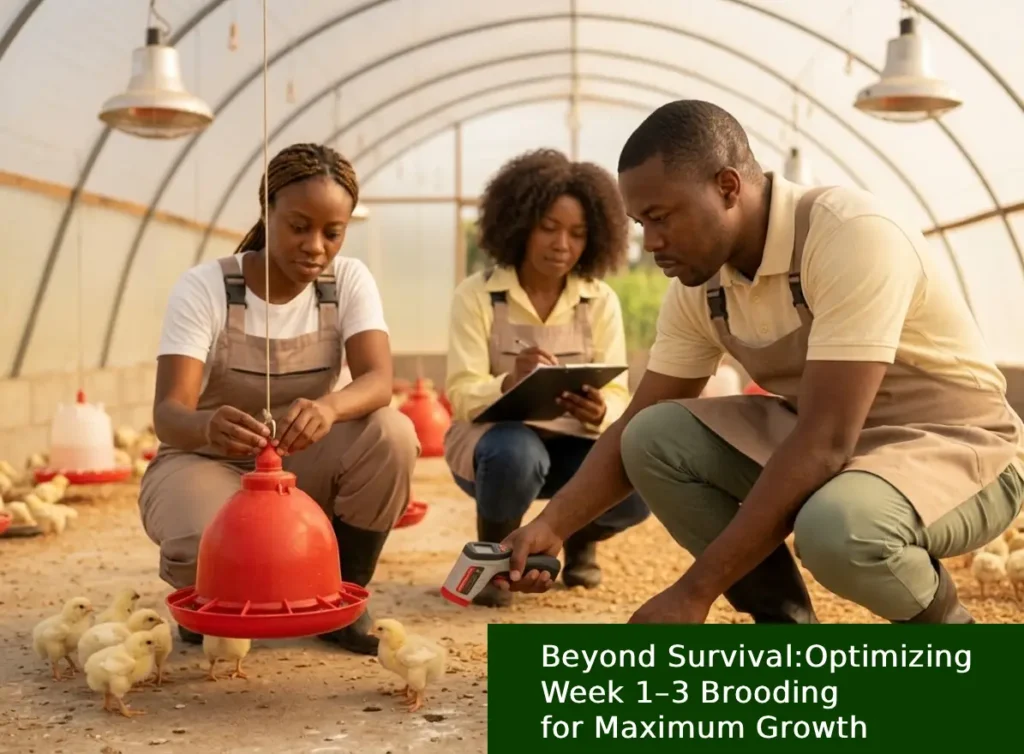
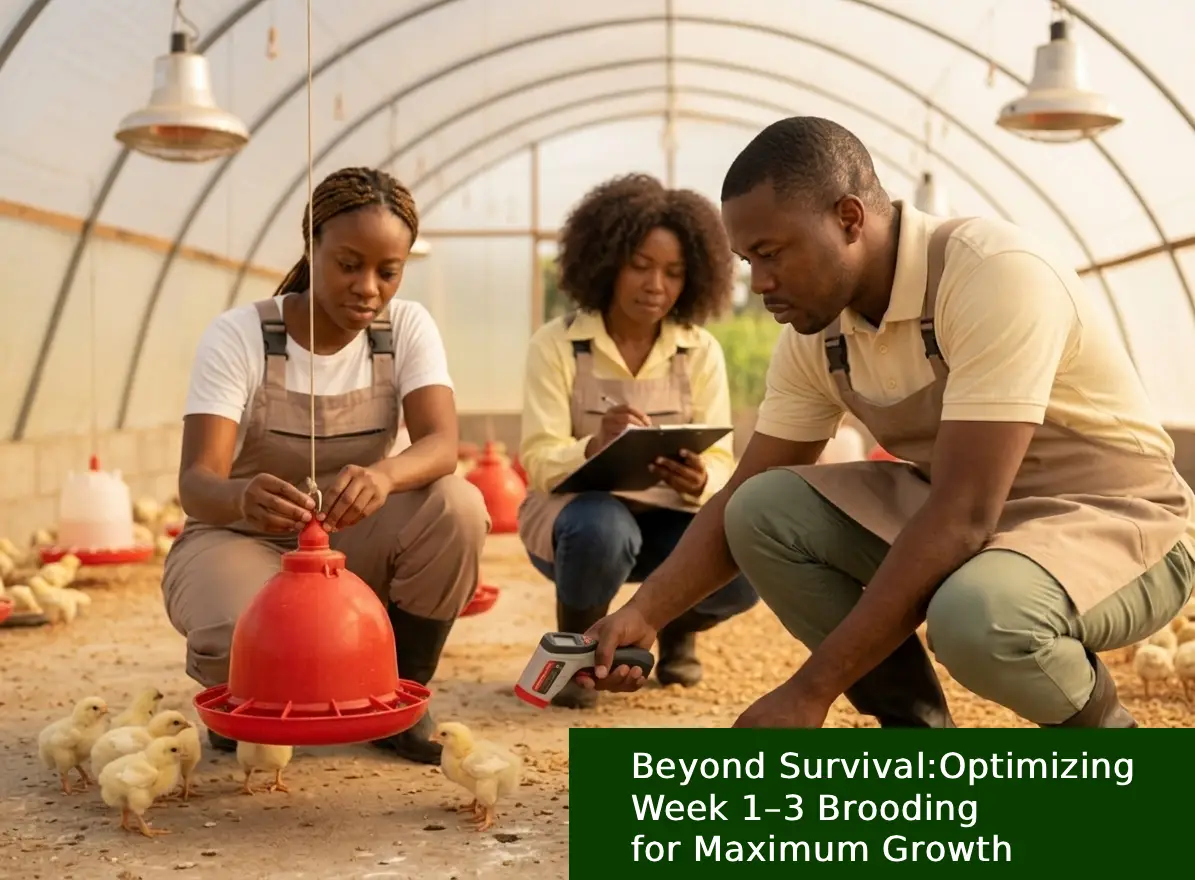
Beyond Survival: Optimizing Week 1–3 Brooding for Maximum Growth

By Ugochukwu Everi
Founder, Essential Farm
I’ve seen farmers celebrate a 1% mortality rate in Week 2, yet their birds are “standing still.” They look okay, but they aren’t growing. Then Week 7 comes, and the birds are 400g underweight. At that point, it’s too late. You can’t feed your way out of a bad start.
At Essential Farm, we don’t just brood for survival. We brood for frame development. If you miss the growth targets in the first 21 days, you’ve already leaked your profit into the litter.
The Problem: The “Uniformity Gap”
The real problem isn’t just small birds; it’s uneven birds. You walk into a pen and see some “giants” and some “dwarfs.”
Most farmers think it’s just bad luck or “genetic variation.” It’s not. What actually happened is that in Week 1, some birds found the water in 2 hours, while others took 12 hours. Some birds were warm, while others were slightly chilled. That tiny gap on Day 3 becomes a massive weight difference by Day 21.
When your flock isn’t uniform, the big birds bully the small ones, the small ones don’t eat, and you end up wasting expensive starter feed on birds that will never hit market weight.
Why Most Farmers Get It Wrong
Farmers focus on Heat when they should be focusing on Metabolism.
They keep the brooder hot—sometimes too hot—and they think that’s enough. But heat is just a tool to get the chick’s internal engine started. If the chick is warm but the air is stuffy (low oxygen) or the water is too far away, that bird isn’t growing.
The hidden mistake? Delayed Feed Access. Every hour a chick spends without eating after arriving at your farm is a permanent loss in gut development. If the gut doesn’t develop in Week 1, the bird can’t process feed efficiently in Week 5. You’ll be pouring money into their beaks, and it’ll just come out as expensive manure.
Systems Over Guessing
The Essential Farm “Growth Acceleration” System
Week 1: The “Internal Engine” Phase
- Pre-Heating: We heat the pen 24 hours before birds arrive. Not just the air, the floor. If the floor is cold, the chick’s feet get cold, their blood flow slows down, and they stop eating.
- The 100-100 Rule: In the first 24 hours, our goal is 100% of chicks with full crops. We check 50 birds randomly. If only 80 have full crops, we failed. We literally move the feed trays closer to the heat source.
- Light Intensity: We use very bright lights (20-40 lux) for the first 3 days. They need to see everything. No “romantic” dim lighting yet.
Week 2: The “Frame Construction” Phase
- Space Expansion: This is where many fail. They keep birds cramped in the brooder ring too long. At Essential Farm, we expand the space by 30% every 3 days.
- Ventilation over Heat: By Day 10, the birds are generating their own heat. We start focusing on fresh air. If you smell ammonia, you are already losing money. Ammonia burns the lungs, and a bird with scarred lungs will never grow fast.
- Water Height: We adjust drinkers daily. If they are too low, birds poop in them. If too high, they don’t drink enough. It should be level with the bird’s back.
Week 3: The “System Stress-Test” Phase
- Heat Withdrawal: By Day 21, except in very cold climates, our birds are off supplemental heat. We want their bodies to learn to regulate temperature.
- Uniformity Check: We weigh a sample of 50 birds. If the “Coefficient of Variation” is higher than 10%, we know we have a management leak. We look for “blind spots” in the pen where birds might be huddling.
The Profit Impact
The Math of the First 21 Days
Average Farm
Day 21 Weight (1.6 FCR)
Essential Farm System
Day 21 Weight (1.35 FCR)
“That 200g difference at Day 21 doesn’t stay 200g. It compounds. By Day 40, that bird is 500g heavier than the ‘average’ bird while eating less total feed. In a 2,000 bird setup, that’s an extra 1,000kg of meat. That’s the difference between buying a new truck and struggling to pay your feed bill.”
Operational Thinking: The “Pen Walk”
When I walk into a brooder, I don’t look at the birds first. I look at the litter.
- ✔ Is it dry? (Wet litter = Coccidiosis = Growth arrest).
- ✔ Is it level? (Uneven litter = Birds huddling in holes).
- ✔ Is the feed clean? (Poop in feed = Disease).
The Practical Takeaway
Starting tomorrow, stop just “checking” your chicks. Get a digital hanging scale. Weigh 20 birds every Sunday. If they aren’t hitting the breeder’s target weight for that week, don’t change the feed yet—change your routine. Check your water height, check your air quality, and for heaven’s sake, make sure they have enough space to run.
Growth isn’t an accident. It’s a result of a system that refuses to let a single bird fall behind.
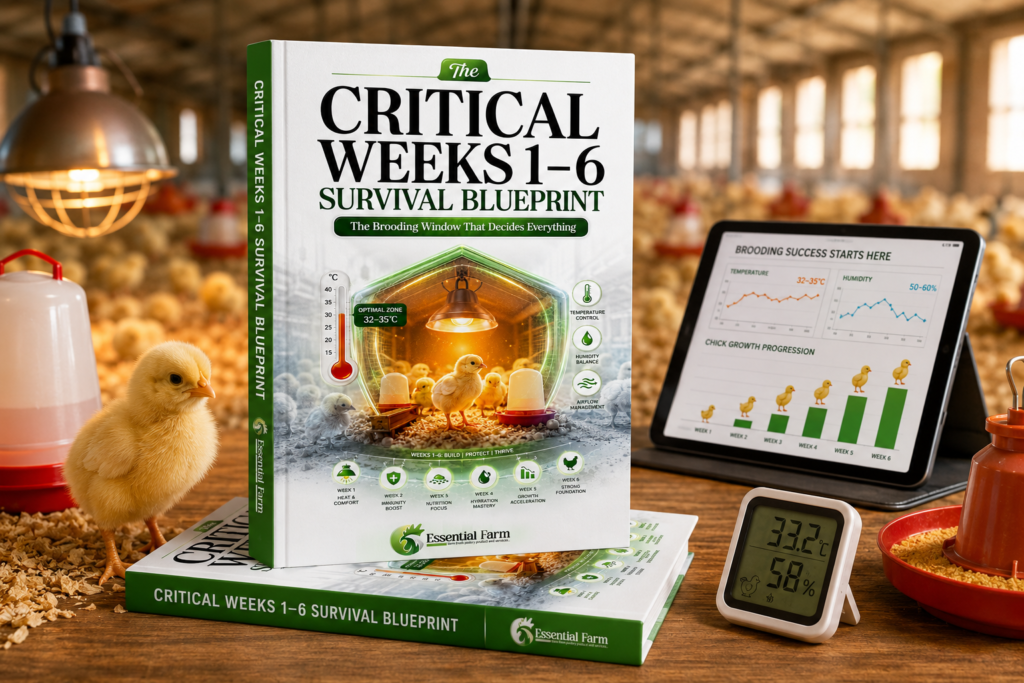
The Ultimate Pullet Development Guide
Master Day 1 to First Egg (Week 18)
Stop losing money in the grower phase. Get the exact systems we use to build high-performance layers that peak at 95% and stay there.
Download The BlueprintThe Essential Farm Blueprint Series