
& 14
Inconsistent Health Management
Quietly Destroys Your Margins
Even the best vaccines, feed, and medications fail when health management is inconsistent. Neglect and shortcuts eat into growth, production, and profit long before you notice.
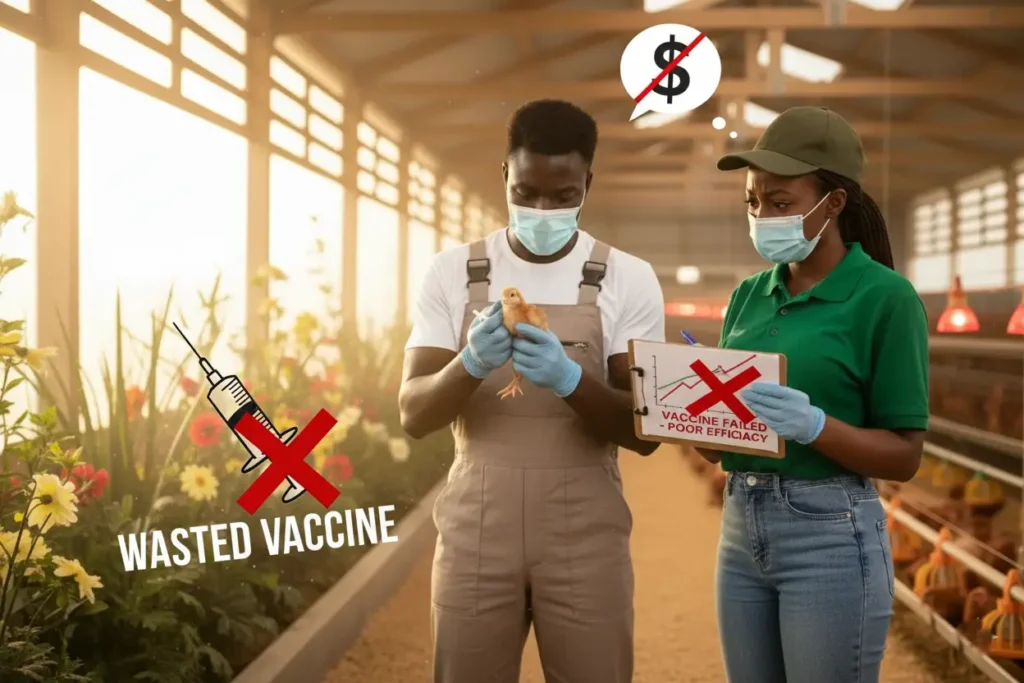
The Vaccine Wasteland
You give a costly vaccine, but don't support the bird around the event. The stress from the shot overwhelms an unprepared immune system, the bird doesn't respond properly — and the vaccine is essentially wasted money.
Get a Quote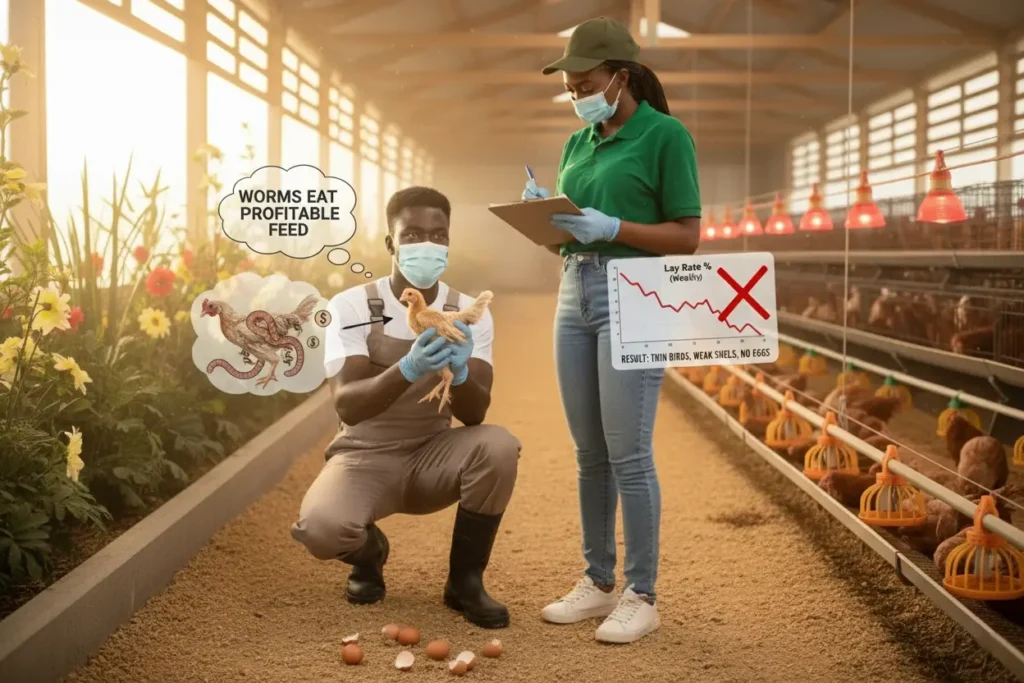
Parasites Steal Your Profit
You skip deworming because it seems like an extra cost. Internal parasites like worms eat your expensive feed from the inside out — leading to thin birds, weak shells, and a sudden, unexplained drop in lay rate.
Get a Quote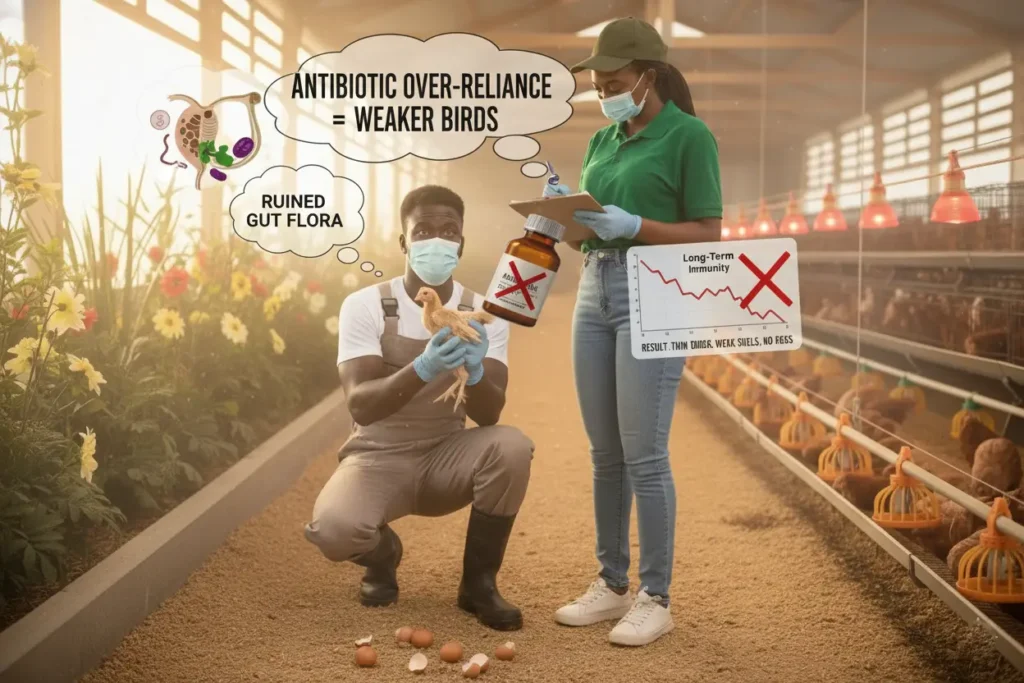
Antibiotic Abuse Backfires
Over-reliance on antibiotics for everything destroys the bird's natural gut flora, reduces long-term immunity, and creates dependency. When a real outbreak hits, your antibiotics no longer work — and your flock has no defence left.
Get a QuoteThe Essential Farm Pre-Emptive Protocol
We manage your flock's health with predictable, non-negotiable timing — so you focus on the profits while we manage the risk.
Protocol 01
Systematic Vaccination Execution
Stress Reduction — 48-Hour Window
Multivitamins and electrolytes administered 24 hours before and 24 hours after every vaccination. This cushions birds against vaccine stress and significantly boosts immune absorption.
Strict Schedule Adherence
Vaccines like ND and Gumboro are administered at the exact time and age specified by the hatchery — with meticulous record-keeping to ensure reliability across every batch.
Post-Vaccination Observation
Close monitoring for two days after every vaccination ensures swift recovery and stress management. Supplementary treatment is deployed immediately if needed.
Protocol 02
Routine Deworming Cycle
Growing Phase — Weeks 9 & 14
You cannot afford to feed parasites. Deworming is initiated at Weeks 9 and 14 during the growing phase — before parasites can establish damaging populations in the gut.
Lay-Cycle Maintenance — Every 6–8 Weeks
Deworming repeats every 6–8 weeks throughout the entire laying cycle. Skipping this allows parasites to eat your feed bill and trash egg shell quality — the most neglected part of farm management.
Debeaking — Week 8–10
Scheduled controlled debeaking during the growing phase prevents cannibalism and directly reduces feed wastage. A direct application of our Farm Management pillar.
Protocol 03
Supplementation & Targeted Treatment
Stress-Event Nutritional Support
Multivitamins and electrolytes are provided during any stressful event — extreme heat, flock transfer, or feed changes. This keeps production stable when the environment demands most.
Anti-Coccidial Management — Days 9–12
Used strictly during the brooding/growing phase at Days 9–12 to eliminate this common killer. Targeted and time-boxed — never continuous, never routine.
Strict Antibiotic Policy
Antibiotics are used only when prescribed by a qualified veterinarian for a confirmed diagnosis. We are not guessing — we are treating only what we know is there.
Vaccination Support — The 48-Hour Window Breakdown
Why Choose Essential Farm for Routine Health?
Our process is documented in our Routine Medication and Supplementation Chart. We're not doing anything on your farm that we haven't already proven in our own 2,500-bird house — every recommendation is battle-tested.
We Follow Our Own Rulebook
Our process is documented and proven in our own 2,500-bird house before it's ever recommended to a client. Every protocol element is field-tested — not textbook theory. You get the same health management system that runs our own operation.
Stress Management Expertise
Our 24-hour Multivitamin/Electrolyte Protocol guarantees that your expensive vaccines are actually effective — reducing the chance of costly failure. Most farms skip this step entirely. We never do.
Predictable Budgeting
You get a fixed, scheduled health plan for the entire year — eliminating surprise costs and emergency spending that come with disease outbreaks. Prevention lets you budget accurately and avoid sudden financial shocks.
Your Questions, Answered
Everything you need to know about preventative health management before booking your consultation.
Diseases cause damage before symptoms appear. By the time birds show visible signs — coughing, diarrhoea, a drop in lay — losses have already occurred. Routine health management prevents disease establishment rather than reacting to outbreaks. Prevention is cheaper, safer, and far more predictable than emergency treatment every time.
Inconsistency renders even the best medications useless. Vaccines fail when birds are stressed. Skipped deworming allows parasites to multiply. Random antibiotic use damages gut health and weakens immunity. These failures quietly reduce growth, shell strength, and egg output — often without obvious warning signs until it's too late to reverse.
We do not simply administer vaccines and walk away. Birds receive multivitamins and electrolytes 24 hours before and 24 hours after every vaccination. This reduces vaccination stress, supports immune response, and ensures the vaccine actually works. Without this support window, vaccines can fail silently — and you'll never know the money was wasted.
Parasites divert calcium, protein, and energy away from egg production — resulting in thin shells, misshapen eggs, lower egg weight, and a reduced laying rate. Even high-quality, expensive feed cannot overcome an active parasite load. Deworming is not optional; it's profit protection.
Antibiotics are used only when absolutely necessary and under a veterinary diagnosis. We never use antibiotics as routine prevention. Overuse destroys the gut bacteria birds need for immunity, creates long-term dependency on medication, and ultimately leaves flocks with no natural defence when a real outbreak hits.
Any stress event — heat waves, flock movement, feed changes, vaccination — triggers nutritional support through electrolytes and multivitamins. Stress weakens immunity faster than disease. Managing stress is therefore a core health strategy, not a comfort measure. We treat it as a non-negotiable protocol element.
This service is critical for farms with recurring health issues, operations heavily reliant on antibiotics, farms with inconsistent or unexplained egg production drops, and any operation seeking long-term health stability and predictable annual budgeting. If you're currently managing health reactively, this service pays for itself within the first cycle.
Real Farms. Real Results.
"I was spending on vaccines every cycle and getting inconsistent results. Essential Farm introduced the 48-hour vitamin support window and I immediately saw a difference in how quickly the birds bounced back. The third cycle under their health protocol was the cleanest, most consistent laying cycle I've ever run. No emergency vet calls. No surprise drops. Just steady production."
Emmanuel O.
Layer Farmer — Enugu State
"I had no idea how much my lay rate was being suppressed by parasites. After the structured deworming cycle, I gained back almost 12% production in six weeks without changing a single thing about my feed."
Mrs. Ifeoma A.
Layer Farm Owner — Onitsha
"My old farm manager was giving antibiotics every time the birds looked slightly off. Essential Farm's policy changed everything — now we only treat what we've actually diagnosed, and the birds are genuinely healthier for it."
Kola B.
Poultry Investor — Abuja
"The annual health schedule gave me something I didn't have before — a real budget. I stopped being surprised by emergency costs. I know exactly what I'm spending on health management every month of the year."
Adaeze N.
Commercial Layer Farmer — Nnewi
Ready for a Health Plan That Pays for Itself?
Stop living in fear of the next outbreak. Get a structured, annual health plan that guarantees peak flock performance — built on the same protocol we run in our own 2,500-bird operation.

"Emergency treatments are expensive. Prevention allows farmers to budget accurately — and avoid the sudden financial shocks that kill otherwise profitable farms."
— Essential Farm